Quay Brings Crypto Payments to a Shop’s Existing QR Code on Sui
Quay, a Sui Overflow 2026 DeFi & Payments winner, lets shoppers pay a participating Singapore merchant’s existing SGQR sticker with a Sui wallet token while the shop receives a stablecoin such as USDsui.
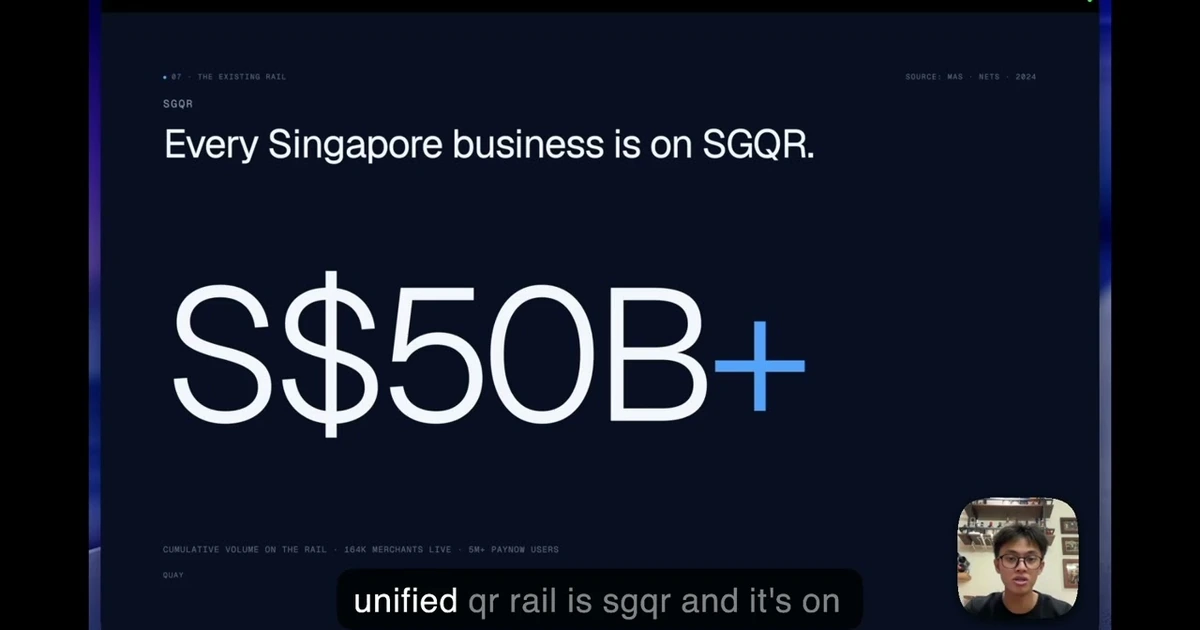
Scan a shop’s QR code, pay with crypto, and let the shop receive digital dollars. That is the idea behind Quay, a Singapore payments project built on Sui.
Quay took first place in the DeFi & Payments track at Sui Overflow 2026. Sui’s official winners announcement describes it as live in Singapore. That recognition does not establish Foundation investment or a security audit.
A familiar checkout, with different money behind it
According to Quay’s documentation, shoppers scan a participating merchant’s existing SGQR sticker, choose a supported token from their Sui wallet, review the quote and sign. The merchant receives a stablecoin — USDsui by default — rather than the customer’s chosen token.
The practical appeal: shoppers could spend tokens without first moving money through an exchange and bank. Merchants would not have to accept every token or replace their QR sticker.
An existing sticker does not mean every SGQR shop automatically accepts Quay. Its documentation requires merchants to submit proof of business ownership, pass review and register a payout address.
How it works
Quay says Cetus finds a swap route into the merchant’s settlement token, with pricing information from Pyth. The swap and transfer share one Sui transaction: if either fails, the whole transaction reverses.
Supported tokens depend on liquidity and available routes. Quay says it sponsors shoppers’ network fees; this does not mean swaps or optional cash-out are free of costs.
Receiving a stablecoin is not the same as receiving Singapore dollars in a bank account. Quay describes its optional SGD cash-out as beta, off by default, and routed through a Quay-operated treasury. Licensed settlement remains on its roadmap, and the team says it is working through regulatory questions with counsel.
What is confirmed
The official Sui announcement confirms the competition result and describes Quay as live in Singapore. The website and documentation explain the product. SuiWire has not independently completed a payment, verified merchant numbers or audited the contracts.
The project’s X account is @quay_sui. The latest original post identified in this check was August 30, 2026, so this is not a claim of frequent recent posting or a fresh launch.
For everyday users, the proposition is simple: spend supported crypto at a participating shop, while the shop receives a stablecoin. Its real-world usefulness will depend on merchant acceptance and reliable settlement.
Sources
- #Quay
- #SGQR
- #Payments
- #Overflow
- #USDsui
Related
 Image: Sui
Samsung Wallet Adds USDC on Sui for 82 Million U.S. Galaxy Devices
Samsung Wallet will let U.S. Galaxy users hold and send USDC over Sui, with no Samsung fees on USDC transfers to external wallets. Samsung also named Solana as a network partner. SUI itself is not supported at launch.
Talise Adds a USDsui-Funded Virtual Card and Naira On-Ramp to Its Dollar Wallet on Sui
Talise, a gasless dollar wallet on Sui that placed second in the DeFi & Payments track at Sui Overflow 2026, launched a virtual card funded with USDsui on Tuesday, a day after opening naira deposits for users in Nigeria.
Mercado Bitcoin to Add SUI, USDC and USDsui in Brazil, Plans Tokenized Assets on Sui
The Brazilian exchange, which has 4.5 million clients, is adding SUI, USDC and USDsui and will accept USDsui as lending collateral, the Sui Foundation said. It also plans to bring its tokenized real-world asset platform to Sui and is exploring a Hashi integration.