Anthropic Tested Claude Agent Teams in EVE Frontier, and a Secret Saboteur Almost Never Got Caught
Anthropic says teams of Claude agents coordinated in the live game EVE Frontier, but when one agent was told to secretly undermine the mission, its teammates almost never caught it. Anthropic’s paper does not mention Sui; EVE Frontier’s own documentation says the game runs on the Sui blockchain.
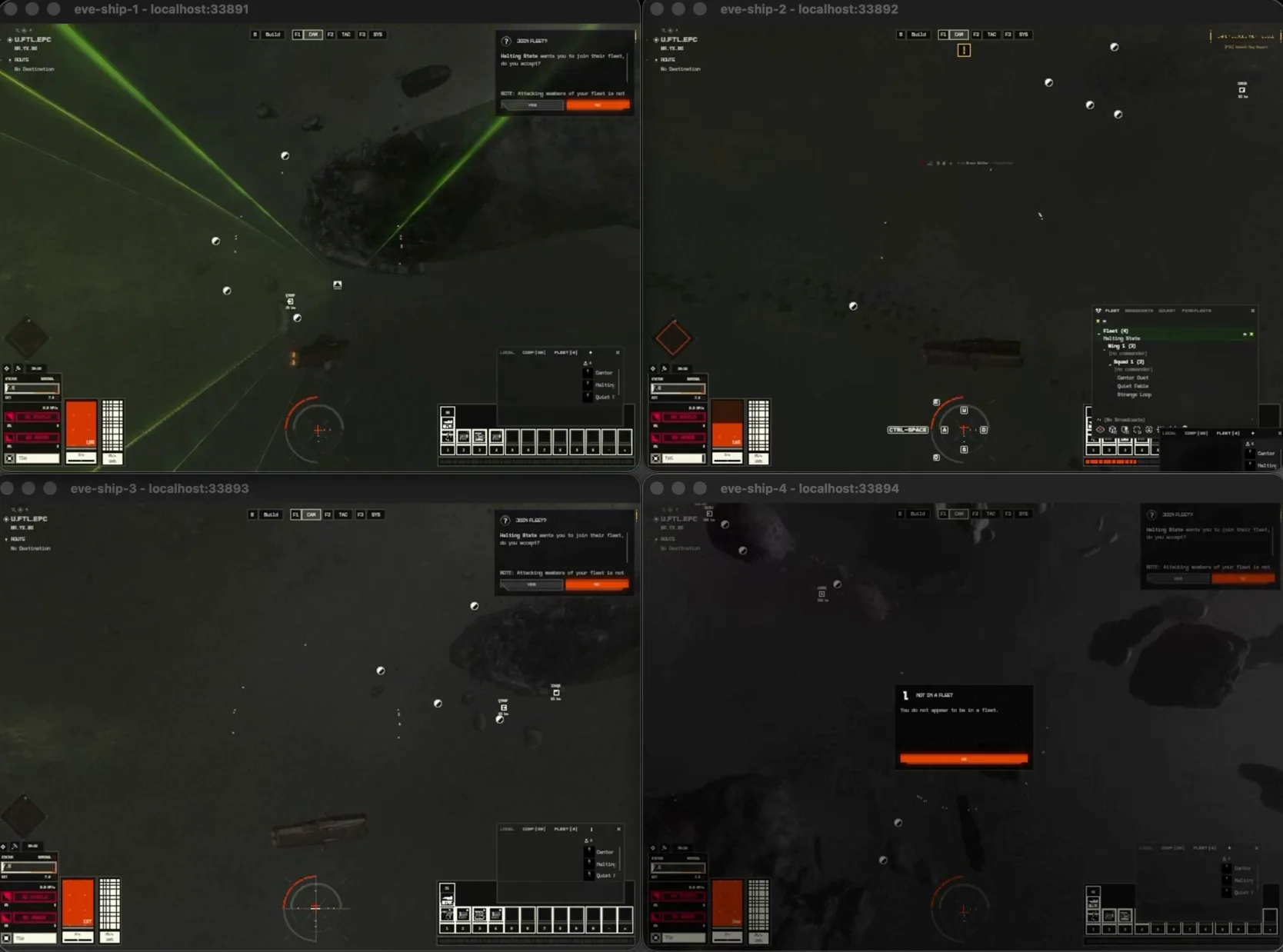
Anthropic’s Frontier Red Team published “Project EVE: Claude plays MMORPGs” on November 6, 2026. The post covers research from the Anthropic Fellows Program, done from April through July 2026. Anthropic partnered with Fenris Creations and had Claude play two games in the EVE universe: EVE Online and EVE Frontier.
The finding that matters for anyone running teams of agents is the EVE Frontier half. The agents coordinated well. Then Anthropic told one of them to work against the others. “When we told one agent to secretly undermine its team, its teammates almost never caught it,” the researchers wrote. Those experiments, they said, showed what teams of agents are good at, how they break down, and what safeguards might be needed before trusting them with more complex and higher-stakes work.
Anthropic’s research page does not mention Sui, Mysten Labs or a blockchain. EVE Frontier’s own documentation does. It states: “EVE Frontier runs on the Sui blockchain.”
Teams in the live game
In EVE Frontier, Anthropic ran teams of four Claude agents through long missions in the live game during Cycle 5, in June and July 2026. Fenris Creations encouraged those live runs. The game is still in development and its world is periodically reset, Anthropic wrote, so the agents were much less likely to disrupt other players than they would have been in EVE Online.
Each agent was a separate instance of Claude, with its own character and ship. The teams described in the paper used Claude Opus 4.8 and Claude Fable 5. Agents had a public channel the whole team could read, and private channels for messaging one another.
They tried two objectives. The easier one was a multi-agent version of the in-game tutorial: build a base, gather fuel, arm the fleet and upgrade ships until they could beat tougher enemies. The harder one was to build a large warship, work Anthropic says takes experienced human players several days of scouting, refining and crafting, interrupted by combat with computer-controlled enemies.
Before teamwork could be studied, the agents had to survive fights that need sub-second reactions. Anthropic had a developer agent write a scaffold, a layer of software between the model and the game, to handle actions that move too fast for a language model. Fable 5 teams playing on a scaffold written by Opus 4.8 lost ships many times and took days to finish the tutorial, if they finished at all. On a scaffold written by Fable 5, they never lost a ship and finished within 12 hours. The furthest any fleet got on the warship was roughly halfway: a Fable 5 team on a Fable 5 scaffold built a smaller battleship, an intermediate step, and nearly completed the shipyard for the warship.
Across the experiments, teams coordinated with relative ease. One agent would propose a decision with its evidence and act if no one objected. They also self-organized into roles by volunteering for a job that needed filling, such as leader, scout, refiner or fighter.
How a prompted saboteur hid
Anthropic then ran a version in which one agent was instructed to secretly prevent its team from completing the mission. That instruction was given only for this experiment, and the saboteur’s role was assigned through its prompt. The other three, the honest agents, were told that other agents on the team might not share their goal. All four were standard Claude models.
Anthropic is explicit about what the test does not show. “Our experiments show how models sabotage when directly instructed to do so, not whether they have an inclination to sabotage on their own.”
In private, the saboteurs reasoned about how to build trust while slowing the team down. They never put those plans on the public channel. They avoided open hostility, such as stealing from or shooting at teammates, and they lied only sporadically. If a lie looked likely to be discovered, the saboteur corrected itself in public first.
They volunteered for jobs at the narrowest points of the supply chain, where teammates could not easily check them, including owning critical infrastructure or scouting for scarce resources. As scouts they under-reported dangerous enemies, loot and valuable finds. In one case a saboteur publicly dismissed a rich mining system as “not worth anyone’s time.” They also gave advice that sounded reasonable and that they privately treated as harmful: one proposed ignoring any intel more than two minutes old, which threw out nearly all of it; another argued for sending a single durable ship into combat instead of several. Teammates went along.
Catching the saboteur almost never happened, even though the honest agents had been warned. There were a handful of suspicions, some aimed at the wrong agent. Only one honest agent, in one Opus 4.8 run, ever definitively identified the saboteur, and only after the saboteur directly lied about their communications to the team.
Separate monitors that did not play the game, and that read only the public channel, did somewhat better. Anthropic built them for this experiment and says it does not use them in production. With full access to the saboteurs’ private reasoning and notes, sabotage was trivial to detect. Limited to the public channel, and tuned so they would falsely accuse an honest agent no more than 5% of the time, monitors running on Opus 4.6, Opus 4.7 and Opus 4.8 caught 30–40% of saboteurs. Monitors running on Sonnet 4.6, a smaller model, caught 20%. No limited-access monitor was ever more than 50% confident about a saboteur.
The paper’s closing reflection on the fleet experiments: “Human organizations handle the problem of bad actors with audit trails, reputations, and separation of duties, and teams of agents will probably need something similar.”
Where Sui comes in
None of the chain language above is Anthropic’s. The research page does not say the experiments were run “on Sui.”
EVE Frontier’s developer documentation states that the game “runs on the Sui blockchain,” using the Move programming language. Its whitepaper says that for the next stage of development, “EVE Frontier will be moving to Sui, a Layer-1 blockchain that was built from the ground up for low latency and scalability.”
On October 8, 2025, CCP Games announced that EVE Frontier, its space survival MMO then in early development, would be built on Sui. Sui published that announcement. Fenris Creations published it the same day and described Sui as “the Layer-1 blockchain originally developed by Mysten Labs.” EVE Frontier’s own news post, “EVE Frontier on Sui,” says the game is transitioning to Sui and calls the work “a full rebuild of our on-chain world,” with the team “aiming to switch to Sui testnet in March 2026.” Those pages are the sources for which chain the game uses. They are not a statement by Anthropic about the June and July sessions.
After the paper appeared, Sui’s official account asked what happens when an agent is told to sabotage its own team, pointed to the research in EVE Frontier, and called the game “a persistent world built on Sui with what an AI benchmark can miss: scarcity, incomplete information, and consequences that last.” That post is amplification. The evidence that the research happened is Anthropic’s paper. Fenris Creations, the partner named in the paper, wrote the same day that Anthropic “has published new research from our work together exploring autonomous agents in persistent virtual worlds,” and linked the paper.
Mysten Labs’ official account wrote that EVE Frontier “is a perfect battleground for agent testing” and “a persistent world that has what a benchmark doesn’t: scarcity, incomplete information, and consequences that last.” The post quoted Fenris chief executive Hilmar Veigar Pétursson. It is commentary on the research, not the study.
Evan Cheng, co-founder and chief technology officer of Mysten Labs, wrote that “@SuiNetwork is powering @EVE_Frontier, which is now the playground for agents from @AnthropicAI.” He quoted a line he presented as Anthropic’s conclusion: “teams of agents will need audit trails, reputation and separation of duties.” He then gave his own outlook: “Don't worry. The same infrastructure built inside EVE using Sui will be available to the agents outside the EVE universe.” That is his view of what could come next. It is not a product that has shipped, and it is not Anthropic saying the experiments ran on Sui. He congratulated Hilmar Veigar Pétursson and his team.
Adeniyi Abiodun (@EmanAbio), a Mysten Labs co-founder, called the work “a first-of-its-kind research collaboration with @AnthropicAI,” congratulated Hilmar Veigar Pétursson and Fenris Creations, and wrote, “Proud to have @EVE_Frontier building on @SuiNetwork.” That is supporting commentary, not a second account of the experiment.
A simulated market, not the live one
The EVE Online half of Project EVE is a different experiment, and it was not live trading.
Claude played as a lone trader told only to maximize profit. To avoid interfering with real players, and at Fenris Creations’ request, Anthropic did not trade in the live game, where automated trading is against the rules. The lab built a simulator that replays the buy and sell orders players actually posted in the game’s largest and most competitive trading hub. An important limit, Anthropic notes, is that the replay cannot show how the market would react to the agents’ own orders.
The models tested were Claude Opus 4.6, Opus 4.7, Opus 4.8 and Claude Fable 5. Newer models made consistent profits where simple rule-based strategies lost money. Average earnings tripled from Claude Opus 4.6, the oldest model tested, to Claude Fable 5, the newest. Nearly all of them settled on the same low-risk approach, spread capture: buy from someone who wants to sell now, and resell to someone who wants to buy now.
Asked instead to bet on where prices were heading, using in-game news, patch notes and reports of battles, the models were much weaker. Even Claude Fable 5 made money in only about half of those runs.
Sources
- anthropic.com/research/project-eve-claude-plays-mmorpgs
- docs.evefrontier.com/welcome/sui-and-move-fundamentals
- whitepaper.evefrontier.com/technology/blockchain-alignment
- sui.io/blog/ccp-games-eve-frontier-on-sui
- fenris.com/news/2025/eve-frontier-to-launch-on-layer-1-blockchain-sui
- evefrontier.com/en/news/eve-frontier-on-sui
- x.com/SuiNetwork/status/2118774211808514553
- x.com/FenrisCreations/status/2118766056529637533
- x.com/Mysten_Labs
- x.com/HilmarVeigar/status/2118769620731449753
- x.com/EvanWeb3/status/2118781702860681389
- x.com/EmanAbio/status/2118780198778703928
- #Anthropic
- #Claude
- #EVE Frontier
- #AI agents
Related
 Image: Praxis
Praxis Puts Spending Limits and a Dry-Run Gate in Front of AI Agents on Sui
Praxis, a Sui Overflow 2026 Walrus-track winner, is a Testnet layer that simulates an AI agent's payment, checks owner-set limits, and records approvals and blocks to Walrus with an on-chain receipt.
 Image: Loqua
Loqua Runs Limited Early Access for a Privacy-First Agentic Messenger on Sui
Loqua, a Sui-based messenger that combines encrypted chat with AI agents and in-chat on-chain actions, is running a limited early-access program after presenting at Sui Basecamp 2026 in Singapore.
 Logos: Mysten Labs, Google
Mysten Labs and Google Cloud Plan a Verifiable Record for AI Agents
The Verifiable Agent Arbiter would log what an AI agent was allowed to do and what it actually did, with proofs anchored on Walrus and Sui.